
Wilbur Building
341 S. Main Street

c. 1875

Built in 1875 by Levi Starr, this building originally housed the Farmers' and Drovers’ Bank, with a millinery and dressmaking shop located in the basement. In 1892, the bank became the Carthage National Bank. In 1907, the bank prepared to move to a new location, and the building entered a new chapter as a center of Carthage’s retail life.
In 1908, Josiah Grant Wilbur purchased the building and leased it to Blankenship & Owens Clothing Co. at which time the building underwent a major remodeling. The upper level received a new stone façade, elegant plate-glass show windows were added, and the rear of the building was extended 50 feet. During later restoration, an entire 1908 Carthage newspaper was discovered beneath a section of wooden flooring, connecting the past to the present.
For approximately 70 years, the building was home to a succession of men’s clothing stores. Blankenship & Owens was followed by Gratz Clothing Co. in 1912, and Carter-Miller Clothing Co. in 1926. After Carter's death in 1937, Miller purchased Carter's interest in the store, creating Miller’s Clothing Co. which remained in business until 1978. Although no longer a retail space, the building continued to serve the community as professional offices.
The basement developed a history of its own, serving as a retail space for women's merchandise and later a restaurant space. In 2013, the building became home to The Palms Massage and Day Spa. In 2023, the historic basement was restored and adapted for use as classrooms for the Palms Massage School, giving this historic commercial building a new purpose while preserving its connection to Carthage’s past.
Like many of the buildings around the Square, the Wilbur Building is an example of how historic preservation and adaptive reuse can give new life to an old building, providing a home for small businesses while preserving a piece of Carthage’s story for future generations.
FUN FACT: Miller’s Clothing Co. used a pulley system to collect payments from customers. An order form and payment were placed in a basket on the first floor and raised by pulley to the upstairs office. There, the payment was processed, and the correct change was placed in the basket and lowered back to the customer.

c. 1968
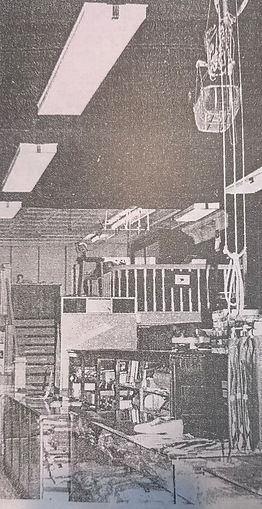
Miller's pulley system