
Central National Bank & Gammon Building
149 E. 3rd Street

c. 1910

Carthage Water & Electric
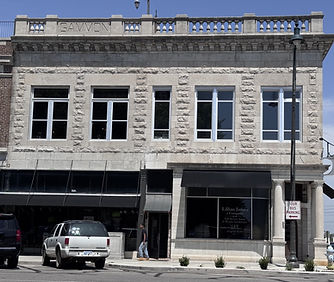
What appears to be one building is actually two separate buildings. The corner building was constructed of brick by Charles Harrington, a pioneer hotelier and major investor in Carthage’s growth, following the devastating fire of 1880 that destroyed much of the north side of the Square. It housed a saloon and billiards hall, with a barber shop added later. In 1890, the Central National Bank received its charter and purchased the building, occupying the first floor while offices were located upstairs.
The building next door housed a variety of businesses, including a grocery store and a farm implement store. In 1905, Charles Gammon, a prominent citizen and mine owner, purchased the former Hatch Building, which was home to the Hatch Clothing Company until it closed in 1908.
In 1907, plans were drawn by prominent Carthage architect J. A. Prather to give the bank and neighboring Gammon Building a more imposing and substantial appearance. Both buildings were refaced with Carthage “marble,” the locally quarried limestone that was also carried around the side of the bank building along Grant Street. The Gammon name was added at this time.
The remodeling included three marble pillars at the bank entrance, large plate-glass windows with prism-glass transoms, and a decorative balustrade along the roofline of both buildings. The interior of the bank was remodeled at this time, while the Gammon Building was remodeled in 1908 to accommodate a new tenant following the closure of the clothing company.
The Gammon Building became home to the Dumars Music Company, later the Dumars-Gammon Music Company, and in 1911, the Gammon Music Company, after Charles Dumars sold his interest to Gammon.
Be sure to notice the sidewalk marker honoring James Scott, who worked at Dumars. Scott is recognized as one of the “Big Three” composers of classic ragtime, along with Scott Joplin and Joseph Lamb.
When Central National Bank consolidated with First National Bank in 1931, it moved to the First National Building. The corner building later became home to Carthage Water and Electric and other businesses. In 2016, it was renovated for Lillian James & Co., and original marble discovered in the basement was once again used on the walls.
Today, the Gammon Building is part of The Gaderian, an events venue. The historic stairway connecting the two buildings has been reopened, and the rooftop has been renovated for weddings and other events, providing a spectacular backdrop overlooking the Jasper County Courthouse.
FUN FACT: James Scott is considered one of the greatest ragtime composers and pianists of all time. Born in Neosho, Missouri, Scott was one of six children of James and Mollie Scott, who were formerly enslaved.
In 1901, Scott moved to Carthage. Although primarily self-taught and gifted with perfect pitch, he studied piano with John Coleman, a Carthage saloon pianist, and Emma Johns DeArmond, a distinguished local piano teacher.
In 1902, Scott began working for Charles Dumars, owner of the Dumars Music Company. Initially performing odd jobs, Scott's musical talent soon became apparent when Dumars heard him play the piano. Recognizing his ability, Dumars had Scott demonstrate songs and pianos for customers.
In 1903, Dumars published two of Scott’s early compositions, A Summer Breeze and The Fascinator, and helped secure opportunities for Scott to perform locally, including at Lakeside Amusement Park, where he became a headliner.
Scott’s first commercial success was Frog Legs Rag, published in 1906 by the Stark Music Company in St. Louis, which also published compositions by Scott Joplin.
For several years, Carthage was home to the James Scott Ragtime Festival. Although the festival is no longer held, Scott’s music continues to be celebrated at ragtime festivals throughout the country.
