BELLE STARR
The Bandit Queen
1848–1889
Side Note
The Carthage Female Academy opened in 1855 and provided a "classical" education including studies in Latin and Greek, ancient history and classic literature, plus the fine arts.
In 1861, the building in the 700 block of South Main Street was danaged by artillery fire and later destroyed during the Civil War. Only the school bell survived. The bell is displayed in what was the Carthage High School but is now the Sixth Grade Center.

HISTORICAL RECORD
Myra Maybelle Shirley, later known as Belle Starr, was born on February 5, 1848, in Carthage, Missouri. She grew up in a prosperous and respected family. Her father, John Shirley, ran a successful inn, tavern, and blacksmith business, and the Shirleys were considered prominent citizens of Jasper County. Belle was educated at the Carthage Female Academy, where she received a “classical” education and learned to play the piano. Close to her older brother Bud, he helped her become an expert shooter and horsewoman.
During the Civil War, Carthage was torn apart by conflict. Belle’s brother Bud became a scout for Quantrill’s Raiders, a group of Confederate sympathizers who engaged in guerilla warfare in Kansas and Missouri. Bud was killed in June 1864 in a skirmish with Union troops. In September, Carthage was burned by Confederate guerillas, including the Shirley home and businesses.
Later writers would claim that young Belle rode with Quantrill’s Raiders or acted as a Confederate spy, but the historic record offers no such proof; these tales appear to be products of legend rather than fact.
EMBELLISHMENTS and LEGEND

HISTORICAL RECORD
After the Civil War left their Carthage home in ruins, John Shirley moved his family to Scyene, Texas, near Dallas. Belle adapted to farm life there but retained the refinement she had acquired in Missouri. During this time, she became acquainted with former Confederate guerrillas, including Jesse James and the Younger brothers, who had ridden with Quantrill’s Raiders and were sometimes said to have hidden at the Shirley farm.
In 1866, Belle married Jim Reed, charismatic former Confederate soldier increasingly involved in horse theft and outlaw activity. For the next eight years, the Reeds lived a restless existence, moving between Missouri, Texas, and Cherokee land in Oklahoma as Reed’s activities forced them to flee one step ahead of the law. During this time, Belle gave birth to her daughter Pearl, born in Missouri in 1868, and her son Ed, born in California in 1871, where Reed had temporarily moved the family in an attempt to escape capture. By 1873, Belle had separated from Reed and returned to her family in Texas. The next year, Jim Reed was killed near Paris, Texas, in an ambush by lawmen.
Following Reed’s death, Belle stayed for a time at the Reed family homestead in Missouri. She also strengthened her ties to the Cherokee Starr family, whom she had first encountered through Reed’s dealings with Tom Starr, a Cherokee horse thief. In 1880, Belle married Sam Starr, Tom’s son.
Belle and Sam settled in a log cabin on the Canadian River in Indian Territory. She named their home Youngers Bend after her longtime friends the Younger brothers. The Starr homestead became known as a gathering place for fugitives, horse thieves, and outlaws, securing Belle’s reputation as a woman who straddled the line between respectability and infamy.
Stories about Belle Starr quickly grew into legend. She was said to ride with Jesse James and the Younger brothers, plotting raids and leading her own band of thieves. The Shirley farm in Texas was remembered as an outlaw hideout, where Belle supposedly entertained fugitives with music and laughter.
Belle's marriage to Jim Reed became part of the myth too, casting them as a romantic outlaw couple, though the truth was less glamorous. Later, at Youngers Bend in Oklahoma, folklore crowned her a queen of the frontier, velvet-clad, armed with a pearl-handled Colt, and ruling over horse thieves and fugitives. Though much of this was embellishment, the stories cemented her enduring image as the “Bandit Queen.”
EMBELLISHMENTS and LEGEND
HISTORICAL RECORD
In 1882, Belle Starr and her husband Sam Starr were arrested for horse theft in Indian Territory. Horse theft was one of the most serious crimes of the frontier, often punished by hanging. They were tried before the famous “Hanging Judge” Isaac C. Parker at Fort Smith, Arkansas.
Both Belle and Sam were convicted and sentenced to nine months in prison. Judge Parker went easy on them, explaining that it was the first conviction for both. Belle served her time at the Detroit House of Corrections in Michigan. This was one of the few confirmed times she faced legal consequences for outlaw activity, and it branded her as a notorious figure in the eyes of the public.
After their release, Belle and Sam returned to Youngers Bend, continuing their association with outlaws until Sam’s death in a gunfight in 1886.
EMBELLISHMENTS and LEGEND
Newspapers at the time sensationalized her arrest, portraying Belle as a “queen of bandits” who commanded gangs of horse thieves. Some accounts claimed she carried herself in court with elegance, dressed in velvet and feathers, charming even Judge Parker with her wit and poise. Later folklore suggested that Belle reveled in the trial, treating it as a stage to display her defiance, though the actual record shows a more subdued proceeding.
The arrest reinforced her legend as a bold, glamorous outlaw woman who lived by her own rules, something rare in the male-dominated world of frontier crime.
After Sam Starr’s death, Belle continued living at Youngers Bend with another outlaw, Cherokee Jim July, who later took the surname Starr. It is believed they entered into a common-law marriage, allowing Belle to retain control of her cabin on Indian land. Life at Youngers Bend grew increasingly turbulent. Her household was unsettled, marked by clashes with her hot-tempered son Ed, and her once-commanding influence among outlaws began to fade.
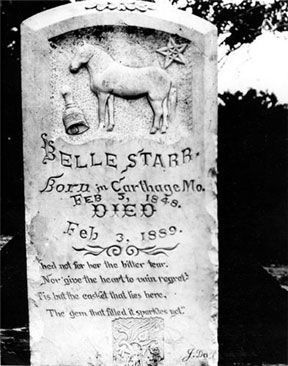
On February 3, 1889, Belle Starr was ambushed while riding home near Eufaula in Indian Territory. Struck down at the age of forty, she died violently and without justice. Her killer was never identified, though suspicion lingered on those closest to her: her son Ed, Jim July Starr, or even hostile neighbors. Her murder remains unsolved.
HISTORICAL RECORD
Belle Starr was buried in 1889 at her homestead on Youngers Bend, along the Canadian River in Indian Territory. Neighbors prepared her body and held a simple frontier funeral, placing her in a homemade pine casket. Six Cherokee men served as pallbearers, and her grave was dug near the front door of her cabin. Local accounts confirm that neighbors filed past the coffin to pay their respects. Not long afterward, the grave was disturbed and reports surfaced that items buried with her had been stolen.
EMBELLISHMENTS and LEGEND
Many details surrounding Belle’s funeral and burial derive from oral tradition and later retellings. Stories claim she was dressed in her finest black velvet riding habit, adorned with jewelry, and cradling a pearl-handled Colt .45 said to have been a gift from Cole Younger.
Another tradition holds that each Cherokee pallbearer dropped a crumb of cornbread into the coffin as part of tribal custom.
While these details have been repeated in popular histories, they are not verified in contemporary newspaper reports and likely reflect the blending of fact and legend that shape her image.
Side Note
The National Police Gazette was a sensationalist New York tabloid and one of the most widely read papers in the United States during the late 19th century. It specialized in crime, scandal, and salacious tales of the Wild West.
After Belle Starr’s arrest and conviction for horse theft in 1882, the Gazette seized on her story. It ran lurid articles that exaggerated her role in outlaw life, portraying her as the “Bandit Queen” who ruled gangs of thieves with beauty, cunning, and a pearl-handled revolver at her hip.
Belle’s involvement in outlaw activity was far less glamorous, but the Gazette’s stories fixed her reputation in the national imagination.
The Gazette also published woodcut illustrations of Belle, often showing her in elegant riding clothes, armed and commanding. These images circulated widely and were among the first visual representations of her legend.
In 1889 the National Police Gazette published “Bella Starr, the Bandit Queen,” a sensationalized account of her supposed exploits. This article launched a flood of popular portrayals: dime novels, pulp magazines, embellished biographies, and eventually Hollywood films that elevated her into the ranks of Jesse James and Billy the Kid. These stories painted her as a whip-wielding, pistol-packing “Bandit Queen” who commanded gangs of outlaws and lived by the gun.
In reality, Belle's life was more constrained. She was a woman tied to outlaws, sometimes complicit in their crimes, but not the larger-than-life leader imagined by popular culture.
Her three-room cabin at Youngers Bend stood until it was destroyed in 1933. Her gravesite, repeatedly vandalized and restored, survives today near Porum, Oklahoma.
In the end, Belle Starr’s story reflects both the rough realities of frontier life and the powerful role of mythmaking. The historic record shows a woman who was educated, twice married to outlaws, and entangled in crime on the margins of Indian Territory. Legend, however, transformed her into America’s most famous female outlaw, the Bandit Queen whose life became larger than death itself.