
CHARLES O. HARRINGTON
1843-1914

Charles O. Harrington played a significant role in shaping the civic and commercial foundations of Carthage, Missouri. Born on December 14, 1833, in Ovid, New York, he was the son of Rev. Ranley Harrington, a Methodist minister. Harrington married Ida A. Britton in Des Moines, Iowa, in 1869. The couple moved to Carthage a year later, raising two children, Alice and Walter. Harrington devoted the next 44 years to the city’s growth and development.
When the Civil War broke out, Harrington left his studies at Geneseo College in Lima, New York, to enlist with Company G of the 27th New York Volunteers. He served with distinction, fighting in major battles from Bull Run to Fredericksburg. Known for his bravery, he was frequently assigned to dangerous scouting missions and endured multiple captures. His daring escapes became part of his legacy, once swimming the James River on a stormy night to escape Belle Isle, and later scaling a prison palisade under fire at Salisbury, North Carolina.
Once in Carthage, Harrington threw himself into civic life. Among his many contributions, he served as lieutenant in the Carthage Light Guard, president of the Carthage Commercial Club (later the Chamber of Commerce), and worked with the Board of Trade to attract new industries. He also belonged to the Miners and Business Men’s Association and the Berry Growers Association, and led the Good Roads Committee. He organized the Fire King Hose Company, Carthage’s first volunteer fire department, and became its first fire chief.
Harrington was instrumental in establishing key institutions, helping to create the city’s first hospital, electric light plant, and public library. He chaired the 1893 Jasper County Courthouse Planning Committee and later served as mayor of Carthage from 1898 to 1900.
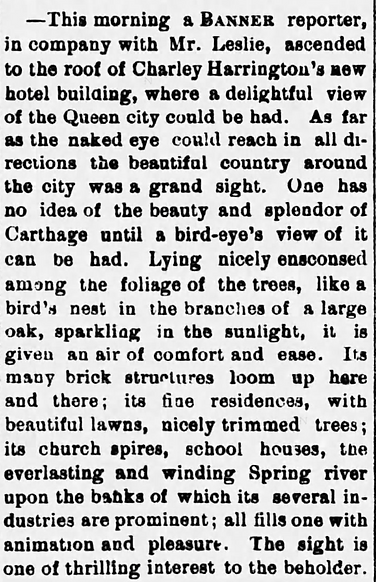
As a builder and developer, Harrington left a lasting mark on the city’s landscape. He constructed the landmark Harrington Hotel in 1881, one of the most elegant and modern hotels in southwest Missouri. The hotel played a major role in the Carthage social scene through the early 1900s and hosted many distinguished visitors. It was demolished in 1940 to make way for a grocery store.

Harrington built the first post office and developed blocks of commercial buildings that housed city offices and the fire department.


Through the Carthage Improvement Company, he oversaw several real estate additions to the city. Beyond town, he operated a 100-acre dairy farm east of Carthage, featuring the largest silo in southwest Missouri, with a capacity of 235 tons. He later built a modest two-story home on his property at the corner of Prospect and Chestnut streets. It still stands as does the carriage step that bears his name.
Socially, Harrington was equally engaged. He was a member of the Elks Lodge and the No Name Whist Club, an informal group of Carthage’s leading men who gathered to play the card game of Whist. He remained active in civic and social life until his health declined near the end of his life.
Through his vision and leadership, Charles Harrington helped guide Carthage through a formative period, leaving behind a legacy that continues to impact the city today.


